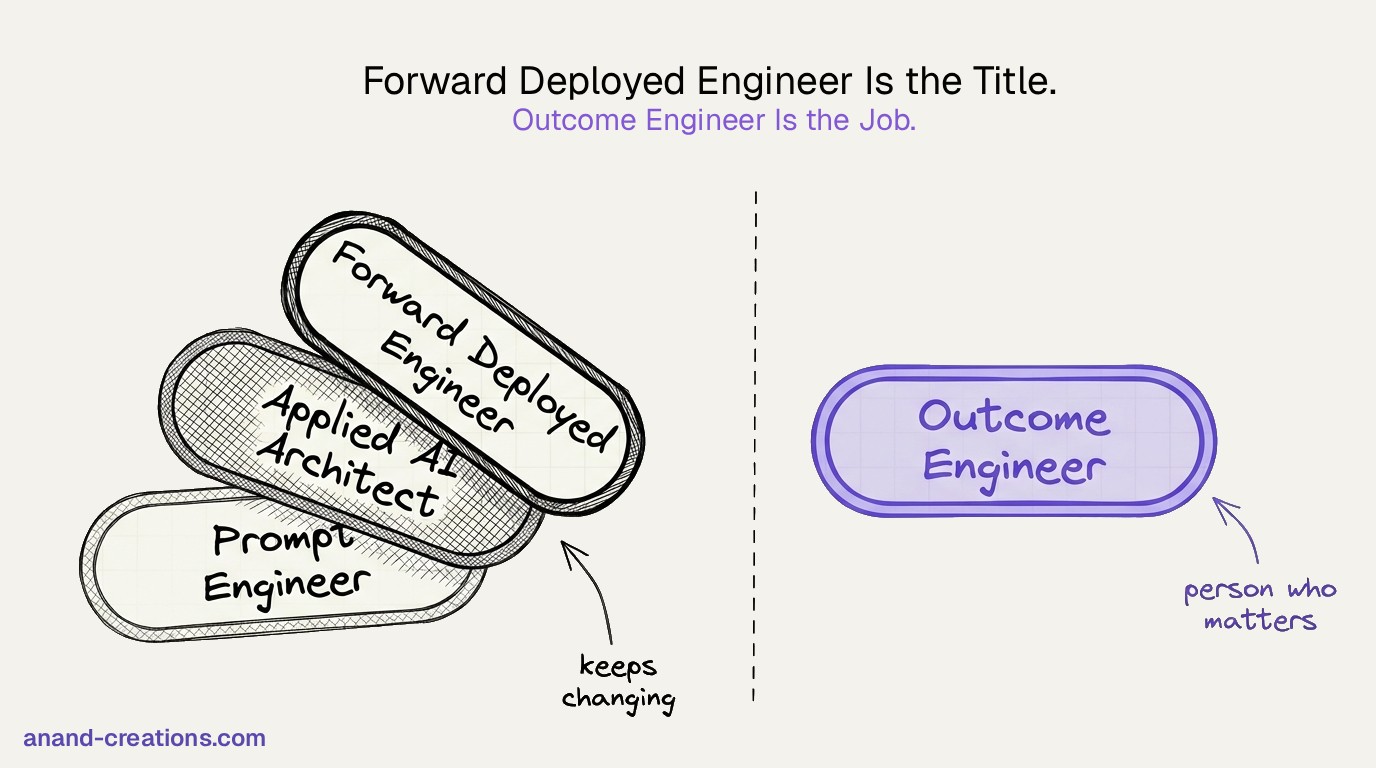
Forward Deployed Engineer Is the Title. Outcome Engineer Is the Job.
Forward deployed engineer is the hottest title in AI. If you want it, aim at the part that never goes stale: owning the outcome. What the title means, why it got hot, and what every posting actually asks for.
The Forward Deployed Engineer is the job title of the year. Postings with the title grew about 42x from 2023 to 2025, and more than 4,900 US roles were open in September 2026 (Aced, from LinkedIn data). OpenAI’s own job board lists FDE base salaries from $153,000 to $325,000, plus equity. Google Cloud runs a ladder of GenAI Forward Deployed Engineer roles, senior through staff, across its regions. a16z called it “the hottest job in startups.”
Rewind to 2023 and the title of the year was “prompt engineer.” Nobody posts that job any more. Same conveyor belt, fresh sticker: the pay climbs, the label churns, and companies keep hiring the noun instead of the result.
I’ve spent this year reading every FDE posting I could find, partly because I’ll hold the title myself from January. This post is what I’d tell an engineer who wants it. The title is real and the demand is real. But the title describes what you are. It says nothing about whether you move a number. Clients pay for the number, and the gap between the two is where most AI budgets go to die.
Where the title comes from
Palantir coined it around 2005, two decades before it became the hot AI title. The AI wave did not invent the job. It made the job urgent.
The idea was borrowed from a forward-deployed soldier: stationed on the ground, close to the problem, ready to act. A Palantir FDE embeds with the client, often onsite three or four days a week, learns how the business actually runs, then ships software that solves that specific problem.
Why it got hot right now
Guess first
In MIT's 2025 study, what share of organisations got no measurable P&L return from their generative AI pilots?
About 95%. The report blames the approach, not the models: pilots that never get wired into real workflows.
Not because the models got worse. Because the models got good and nothing changed. Accenture’s Pulse of Change survey puts widespread, sustained value from AI at 23% of companies, down from 32% earlier in 2026. Models don’t deploy themselves. Someone has to sit inside the mess, wire the thing into the real stack, and make a number move. That someone is expensive and rare, so the title got hot.
The classic FDE deploys a product. Someone else’s.
At Palantir, the FDE configures Palantir’s own platforms, Foundry and Gotham. At OpenAI, the FDE ships OpenAI’s models. At Anthropic, the same job runs under the name Applied AI Architect and deploys Claude into a client’s stack. Palantir is explicit that this is not advisory work: the FDE assembles a pre-built product to fit the client, and the clever field work gets fed back so the product itself gets better. FDEs build many capabilities for one client; the product team turns that into one capability for many clients.
That loop is the actual business model. The employer eats the cost of embedding an expensive engineer because every deployment sells more product and sharpens it. The FDE is a spearhead for a platform, and the loop is the part of the title worth having.
Now strip the platform away. Take the title at a company with no product to deploy, and what is left? An engineer embedded at a client, building. That is a contractor with a fashionable badge. A good one, maybe. But you are a seat, not a spearhead, and your work stops compounding when the contract ends. If you want the real version of the job, pick a role with a product behind it and a product team on the other end of the loop.
The title is not the filter
What made Palantir FDEs work is a rare bundle: the social read to embed in someone else’s org without friction, the tolerance to sit in ambiguity, and the velocity to ship value before patience runs out. OpenAI and Google pay a quarter-million-plus base for that profile, and they screen for the traits, not for the badge on your CV. Ex-Palantir FDEs go on to found startups at a wild rate, because the same traits make founders.
And a title is an input. You can hold the badge and still not move the number. The 95% of pilots that went nowhere were not staffed by bad engineers. They were staffed against no defensible metric, in a demo environment, with no one owning what happened after the applause.
What every posting actually asks for
Company size changes the wording. It does not change the shape. Four things show up almost everywhere:
- Own it past the demo. Ship into the client’s real system and keep it running: on call, debugging, watching it in production. A working prototype is the start of the job.
- A trait bar, not just a skill bar. “Comfortable with ambiguity,” “bias to ship,” “high agency,” “low ego.” Some companies put it above the technical requirements.
- Feed the field back. Turn what you build for one client into something the next ten clients can use.
- Python, plus one more. TypeScript most often, sometimes Java, Go, or the employer’s own platform language.
At the frontier labs the technical half runs deep: cloud architecture, retrieval pipelines, multi-agent frameworks, evals, several years in production, comfort presenting to executives. At small product companies it is wider and shallower: full-stack generalist, direct API integration, often no years requirement at all. The ambiguity bar does not shrink at either end. At the smallest teams it is close to the whole job.
The interview loops match the postings. In one FDE loop this year, the technical panel spent its whole hour on how the candidate handles stakeholders. No whiteboard, no take-home. The panel was testing the trait bundle above: judgment under ambiguity, not a clean diagram.
The question that pays: what number moves?
Strip the label and the useful part is a shape of work. Practise the shape and the title follows:
- Pick one place AI moves a real number. Revenue up or cost down. Name it before any code.
- Ship it into the client’s stack, behind their auth, with evals and observability so they can trust it.
- Hand it off. Runbooks, coaching, a named owner. The capability stays after you move on.
Every AI project I’ve seen work started this way, long before the work had a trending name. An LLM pipeline that replaced a translation vendor started with the vendor’s invoice and a six-week deadline. Sales agents that tripled sales-approved outbound meetings started with the meetings number and a sales leader who owned it. None of them started with “hire someone forward-deployed.” They started with a number and a sponsor.
Four questions to ask yourself
Whether you want the title or already have it, four questions separate an outcome owner from a seat filler. Answer them about the project you are on right now.
Check yourself
Are you an FDE?
You are the engineer. Your employer is the company you work for. The client is the company you deploy into.
- Can you name the number your work moves?
What to doBefore the next line of code, ask the client which metric they care about and who owns it. Write both down.
- Does your work run in the client’s real systems?
What to doPush past the demo. Ask for access behind their login, on their data, early. A demo on your own setup proves nothing about theirs.
- Is it agreed who owns it after you leave?
What to doSettle it before go-live: the client’s team or your employer’s support. Leave runbooks. If nobody owns it, your work dies when you move on.
- Do you build for their problem, not just install your product?
What to doFind one thing the client needs that the product cannot do, and build it. Then feed it back to your product team. That loop is the job.
What outlasts the title
Titles trend and cool. Forward Deployed Engineer is a good one, because underneath the hype it points at something true: the gap between a capable model and a result is human, and someone has to close it in the field. But it might cool like prompt engineer did.
The one title that never goes stale is Outcome Engineer: whoever owns the number, ships it in the client’s stack, and leaves it moving after they are gone.
From January the badge on my profile will say Forward Deployed Engineer, with a product and a loop behind it. I’ll score the work the way I always have: which number moved, who owns it now, and whether it is still moving after I’ve gone on to the next client.